
01
Prepare
Plan routines, transitions, outings, and known challenges before they happen, with prompts your team can actually use.
In practiceA visual schedule and sensory plan, ready for the dentist appointment on Thursday.
Voice or text guidance for the whole care circle, and a shared plan that keeps everyone responding the same way. See how it works in three moments.
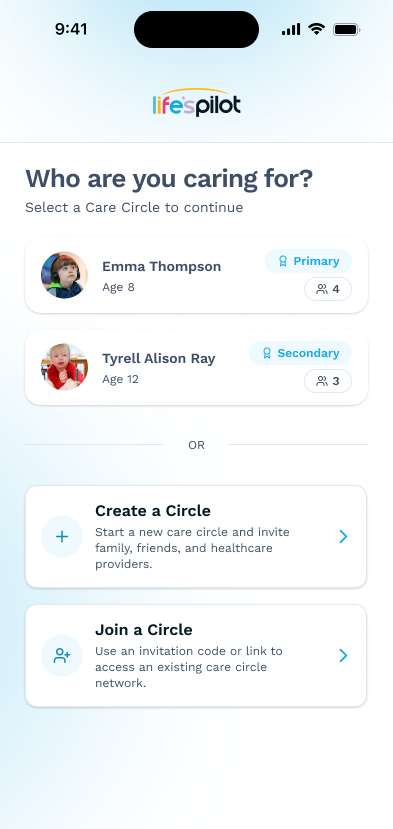
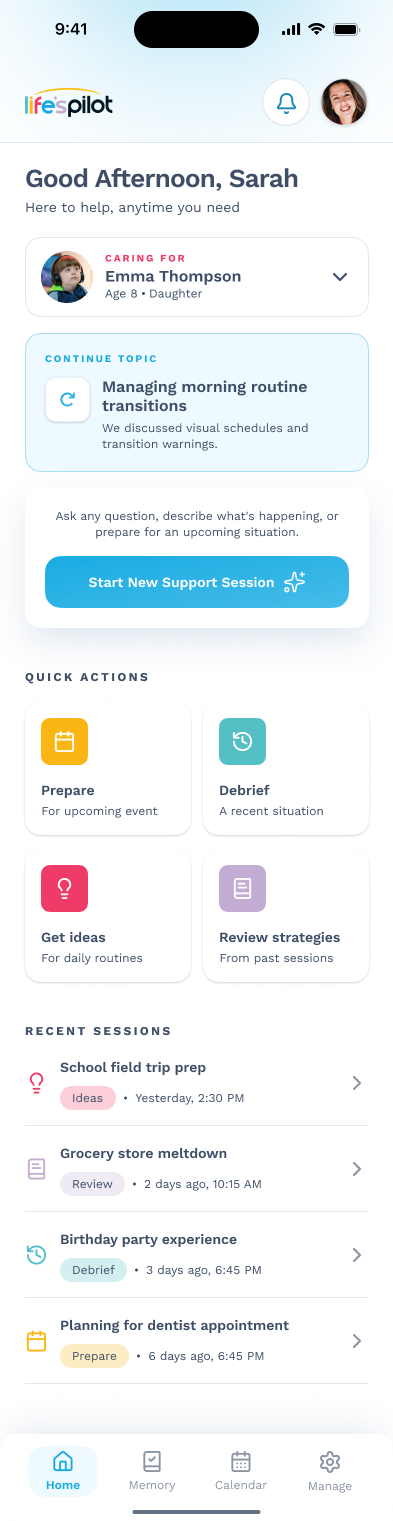
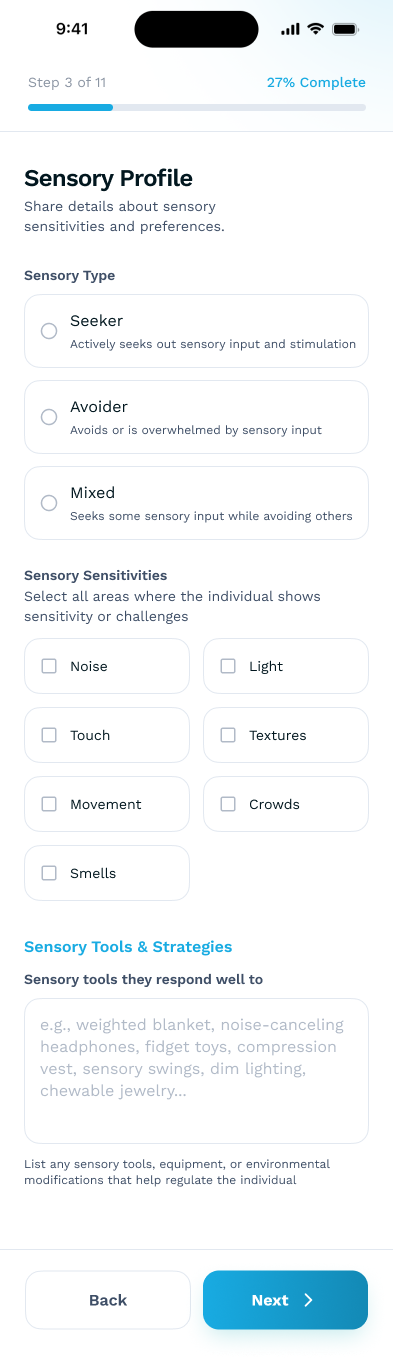
Voice or text. Anywhere. Anytime. “Shoes won’t go on” or “School pickup’s rough”, the Pilot meets you where the day is.
Evidence-informed guidance, personalized to the person you support and the situation you’re in. Calm, clear, immediately usable.
A summary card is auto-saved. The shared plan updates for the whole care circle. No retyping, no “what happened?” texts.
Every challenging moment has a shape. Life’sPilot is built around all of it, not just the part a therapist can see.
Plan routines, transitions, outings, and known challenges before they happen, with prompts your team can actually use.
In practiceA visual schedule and sensory plan, ready for the dentist appointment on Thursday.
In-the-moment guidance through a warm, human-like Pilot, by voice, text, or video, whichever you can use right now.
In practiceA 30-second voice script for de-escalating in the cereal aisle, while you keep your hands on the cart.
Capture what’s working, what’s not, and what changed, across home, school, therapy, and everyone in the care circle.
In practiceA weekly pattern that shows mornings improve when bedtime stays under 9:15pm.
After hard moments, and good ones, guided reflections help you reset, name what worked, and plan the next step.
In practiceA 2-minute summary, automatically shared with Saturday’s babysitter and Monday’s BCBA.
Sixty seconds with the AI Pilot: what it does, how it shows up, and why the care circle stays aligned across home, school, and care visits.
Voice & text help
Speak or tap. The Pilot listens.
One shared plan
Everyone in the care circle stays aligned.
Always there
Help at 8pm, between appointments, in the parking lot.

When a parent updates the morning routine, the school sees it. When the BCBA shares a new strategy, the grandparent sees it. When the speech therapist logs a win, everyone celebrates.
Two cards, same scenario: what Tuesday morning feels like without Life’sPilot, and what it feels like with it.
You try the trick that worked last week. Doesn’t land. School pickup’s in 15 minutes. You text the BCBA, but they’re in another session. You guess.
→ Different response. Escalating stress. Late to school. You’re already drained at 8 AM.
You voice-message your Pilot. It surfaces the calm script your BCBA shared, plus the 3-step transition prompt that worked last Thursday.
→ Consistent response. Shoes on in 4 minutes. School on time. Your morning still has runway.
Illustrative scenario, not a customer story.
Join the waitlist. We’ll be in touch as openings come up, with real-time Pilot guidance and one shared plan.
Supporting a child? See Life’sPilot for children. Supporting an adult? See Life’sPilot for adults.
Built on protected infrastructure.
Same guidance, every language.
Your data is yours.
Clinical advisory board.